

- Seen : 1686 View
- established year : 1911
- Phone : 1-844-764-2665
- Fax : 1-844-764-2665
- Instagram : chevrolet
- Brand : Chevrolet
- website : https://www.chevrolet.com/
- youtube link : https://www.youtube.com/user/Chevrolet
- Address : Chevrolet Customer Assistance Center-P.O. Box 33136-Detroit, MI 48323-5136
-
About us :
On November 3, 1911, Swiss race car driver and automotive engineer Louis Chevrolet co-founded the "Chevrolet Motor Company" in Detroit with his brother Arthur Chevrolet, William C. Durant and investment partners William Little (maker of the Little automobile), former Buick owner James H. Whiting,[6] Dr. Edwin R. Campbell (son-in-law of Durant) ...
More -
About us :
On November 3, 1911, Swiss race car driver and automotive engineer Louis Chevrolet co-founded the "Chevrolet Motor Company" in Detroit with his brother Arthur Chevrolet, William C. Durant and investment partners William Little (maker of the Little automobile), former Buick owner James H. Whiting,[6] Dr. Edwin R. Campbell (son-in-law of Durant) and in 1912 R. S. McLaughlin CEO of General Motors in Canada.
Durant was fired from his senior management position at General Motors in 1910, a company that he had founded in 1908. In 1904 he had taken over the Flint Wagon Works and Buick Motor Company of Flint, Michigan. He also incorporated the Mason and Little companies. As head of Buick, Durant had hired Louis Chevrolet to drive Buicks in promotional races.[7] Durant planned to use Chevrolet's reputation as a racer as the foundation for his new automobile company. The first factory location was in Flint, Michigan at the corner of Wilcox and Kearsley Street, now known as "Chevy Commons" at coordinates 43.00863°N 83.70991°W, along the Flint River, across the street from Kettering University.
One of the technical advancements Chevrolet benefited from was the implementation of an overhead valve engine from the very beginning, as the company was developed as a junior model to Buick, who had patented the overhead valve and cross-flow cylinder design as being more efficient than the conventional use of the flathead engine.
Actual design work for the first Chevy, the costly Series C Classic Six, was drawn up by Etienne Planche, following instructions from Louis. The first C prototype was ready months before Chevrolet was actually incorporated. However, the first actual production was not until the 1913 model. So in essence there were no 1911 or 1912 production models, only one pre-production model was made and fine tuned throughout the early part of 1912. Then in the fall of that year the new 1913 model was introduced at the New York auto show.
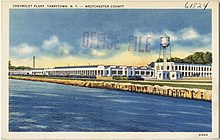 Chevrolet plant in Tarrytown, NY, c. 1918
Chevrolet first used the "bowtie emblem"[8] logo in 1914 on the H series models (Royal Mail and Baby Grand) and The L Series Model (Light Six). It may have been designed from wallpaper Durant once saw in a French hotel room.[9] More recent research by historian Ken Kaufmann presents a case that the logo is based on a logo of the "Coalettes" coal company.[10][11] An example of this logo as it appeared in an advertisement for Coalettes appeared in the Atlanta Constitution on November 12, 1911.[12] Others claim that the design was a stylized Swiss cross, in tribute to Chevrolet's home country.[13] Over time, Chevrolet would use several different iterations of the bowtie logo at the same time, often using blue for passenger cars, gold for trucks, and an outline (often in red) for cars that had performance packages. Chevrolet eventually unified all vehicle models with the gold bowtie in 2004, for both brand cohesion as well as to differentiate itself from Ford (with its blue oval logo) and Dodge (who has often used red for its imaging), its two primary domestic rivals.[14]
 1929 Chevrolet Firebrigade, Porto
Louis Chevrolet had differences with Durant over design and in 1914 sold Durant his share in the company. By 1916, Chevrolet was profitable enough with successful sales of the cheaper Series 490 to allow Durant to repurchase a controlling interest in General Motors. After the deal was completed in 1917, Durant became president of General Motors, and Chevrolet was merged into GM as a separate division. In 1919, Chevrolet's factories were located at Flint, Michigan; branch assembly locations were sited in Tarrytown, N.Y., Norwood, Ohio, St. Louis, Missouri, Oakland, California, Ft. Worth, Texas, and Oshawa, Ontario General Motors of Canada Limited. McLaughlin's were given GM Corporation stock for the proprietorship of their Company article September 23, 1933 Financial Post page 9.[15] In the 1918 model year, Chevrolet introduced the Series D, a V8-powered model in four-passenger roadster and five-passenger tourer models. Sales were poor and it was dropped in 1919.
Beginning also in 1919, GMC commercial grade trucks were rebranded as Chevrolet, and using the same chassis of Chevrolet passenger cars and building light-duty trucks, sharing an almost identical appearance with GMC products.
Until 1921, Chevrolet Corporate headquarters were located at 57th and Broadway in New York City until April when the office was relocated to the General Motors Building at Cadillac Place in Detroit.[16] In January 1921 a General Motors management survey recommended that the Chevrolet Division be cancelled, but Alfred P. Sloan Jr. recommended that the division be saved and William S. Knudsen, a former Ford employee who oversaw production of the Model T,[16] was made Vice President of Operations and performance improved[16] In May 1925 the Chevrolet Export Boxing plant at Bloomfield, New Jersey was repurposed from a previous owner where Knock-down kits for Chevrolet, Oakland, Oldsmobile, Buick and Cadillac passenger cars, and both Chevrolet and G. M. C. truck parts are crated and shipped by railroad to the docks at Weehawken, New Jersey for overseas GM assembly factories.[16]
Chevrolet continued into the 1920s, 1930s, and 1940s competing with Ford, and after the Chrysler Corporation formed Plymouth in 1928, Plymouth, Ford, and Chevrolet were known as the "Low-priced three".[17] In 1929 they introduced the famous "Stovebolt" overhead-valve inline six-cylinder engine, giving Chevrolet a marketing edge over Ford, which was still offering a lone flathead four ("A Six at the price of a Four"). In 1933 Chevrolet launched the Standard Six, which was advertised in the United States as the cheapest six-cylinder car on sale.[18] During the Great Depression the Chevrolet Master introduced a streamlined appearance, showing Art Deco influences and before and after the World War II era, the Chevrolet Deluxe and Chevrolet Fleetline found many buyers.
Chevrolet had a great influence on the American automobile market during the 1950s and 1960s. In 1953 it produced the Corvette, a two-seater sports car with a fiberglass body. In 1957 Chevy introduced its first fuel injected engine,[19] the Rochester Ramjet option on Corvette and Chevrolet Bel Air passenger cars, priced at $484 ($4,670 today).[20] In 1960 Chevrolet joined the newly popular "compact car" market by introducing the Corvair, with a rear-mounted air-cooled engine. In 1963 one out of every ten cars sold in the United States was a Chevrolet.[21]
During the 1960s and early 1970s, the standard Chevrolet, particularly the deluxe Chevrolet Impala series, became one of the United States' best selling lines of automobiles in history. During that era, the mid-sized Chevrolet Chevelle which was used to introduce the Chevrolet Monte Carlo, and the economically priced Chevrolet Nova, which was the basis for the Chevrolet Camaro, all were commercially successful and included family sedans, practical station wagons, and sporty coupes and convertibles. As the popularity of small, fuel efficient imported vehicles began to find buyers in the US during the 1970s and 1980s, the Chevrolet Vega was introduced while the Chevrolet Chevette was the result of international collaboration. By the mid-1980s, the Vega was gone and the Chevette was about to be discontinued. Lacking a line of competitive small cars, Chevrolet imported several Japanese models and re-badged them as Chevrolets. The Suzuki-sourced Chevrolet Sprint and the Isuzu-supplied Chevrolet Spectrum were a better match to compete against the popular Toyota Corolla and Honda Civic. The Chevrolet Citation was the division's first compact sized front-wheel-drive car along with the Chevrolet Cavalier, followed up by the Chevrolet Celebrity. Chevrolet during the 1990s formed a partnership with Toyota and introduced the Geo Prizm while also offering the domestically produced Chevrolet Corsica. As mid-sized family sedans began to gain popularity, the Chevrolet Lumina found many buyers and as minivans began to find buyers, the Chevrolet Venture followed the popular selling Chevrolet Trailblazer and Chevrolet Traverse SUV's.
The basic Chevrolet small-block V8 design has remained in continuous production since its debut in 1955, longer than any other mass-produced engine in the world, although current versions share few if any parts interchangeable with the original. Descendants of the basic small-block OHV V8 design platform in production today have been much modified with advances such as aluminium block and heads, electronic engine management, and sequential port fuel injection. Depending on the vehicle type, Chevrolet V8s are built in displacements from 4.3 to 9.4 litres with outputs ranging from 111 horsepower (83 kW) to 994 horsepower (741 kW) as installed at the factory. The engine design has also been used over the years in GM products built and sold under the Pontiac, Oldsmobile, Buick, Hummer, Opel (Germany), and Holden (Australia) nameplates.
Close