
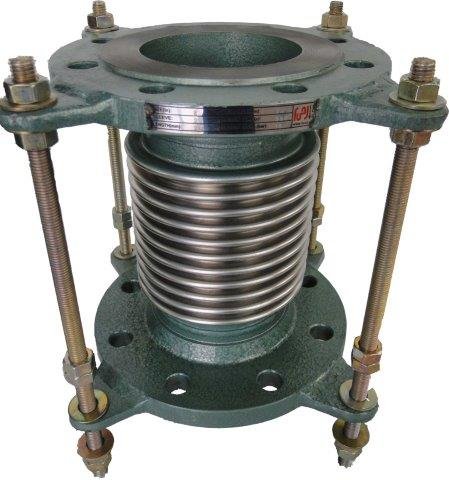
Accordion joints (tension)
  • Seen : 630 View

0
Accordion joints (tension)

Application: Accordion joints in Ducting and Piping are used in various industries to absorb dimensional changes.
Description:
In systems that talk about fluid transmission. Unwanted moves appear. The origin of these movements can be the temperature changes caused by the fluid or the environment, the vibration of the system in the system, such as a pump, a compressor, etc., or movements caused by external factors such as wind, earthquake, structure assembly, etc. Flexible joints are used to capture movements and not transfer them to existing machines and pipelines.
Bearing a high degree of pressure and high pressure and absorbing axial, lateral and angular motion, taking into account the proper arrangement, including the characteristics of the accordion joints, which makes them widespread in various piping and ducting systems in various industries, including water, oil, gas, petrochemicals , Power plants, iron and steel industry, steel complexes, air conditioners and so on.
Below are some of the uses of these components.
• Accordion fittings

Heating and air conditioning systems
Types of steam, combined cycle, hydroelectric and nuclear power plants
Oil and gas refineries
Petrochemical Industries
steel Industries
Cement industry
Heat Exchangers
Wood and paper industry
Exhaust outlet of combustion engines


Various parts of the accordion joints

1) Jumper: The flexible part is an accordion connection that is capable of performing the desired moves.
2. Tubing: The flexible part is an accordion joint that is capable of performing the desired movements.
3- Collar: In flanged fittings, the interface between the flange and the blouse is connected to the pipeline directly in the fusion joints.
Flange: The task of connecting an accordion connection to the cross flange in the pipeline.
5. Internal pods: It prevents the movement of fluid inside the pump to allow a gentle flow. If the velocity of the fluid is high and does not use the inner pod, the phenomenon of turbulence will occur, causing noise, pressure drop, wear and temperature rise.
6- Base Cover: Hoodie.
7. Curtain: The blues are used to keep the blues safe from damage caused by external factors or preventing splashing the fluid in case of possible leakage from the blues.
8. Base of the restraint: Hold the restraint.
9. Cavitation: It resists components with lateral and angular forces against force, and in the case of parts with axial movement, it is necessary to restrict the connection movement in order to prevent unwanted movement of the piece. In which case we say it.
10. Regulator ring: In cases of high pressure, reinforcement rings are used to strengthen the blues. In addition to the reinforcement of the type of rims, the amount of blade force is also adjusted.
11. Rim Base: Holds end rims.
12. Pipe base: Hinge plate holders are in the hinges and the carriage.
13. Tube: In addition to force resistance - Allows an angular movement on a plate for hinged parts in all directions of the carriage.
14. Hinge: The side of the hinges on the body parts is pin.
15-Pin: Plugs into hinged parts and a carriage in the hinges
Specifications: A flexible steel connection in different directions

Saler Company Information

Company : Iran Industrial Vibrations
Phone : 00982188736766
More Information : View
Online order registration form
No comments have been posted yet
loading
Your comment has been sent
Accordion joints (tension)

Application: Accordion joints in Ducting and Piping are used in various industries to absorb dimensional changes.
Description:
In systems that talk about fluid transmission. Unwanted moves appear. The origin of these movements can be the temperature changes caused by the fluid or the environment, the vibration of the system in the system, such as a pump, a compressor, etc., or movements caused by external factors such as wind, earthquake, structure assembly, etc. Flexible joints are used to capture movements and not transfer them to existing machines and pipelines.
Bearing a high degree of pressure and high pressure and absorbing axial, lateral and angular motion, taking into account the proper arrangement, including the characteristics of the accordion joints, which makes them widespread in various piping and ducting systems in various industries, including water, oil, gas, petrochemicals , Power plants, iron and steel industry, steel complexes, air conditioners and so on.
Below are some of the uses of these components.
• Accordion fittings

Heating and air conditioning systems
Types of steam, combined cycle, hydroelectric and nuclear power plants
Oil and gas refineries
Petrochemical Industries
steel Industries
Cement industry
Heat Exchangers
Wood and paper industry
Exhaust outlet of combustion engines


Various parts of the accordion joints

1) Jumper: The flexible part is an accordion connection that is capable of performing the desired moves.
2. Tubing: The flexible part is an accordion joint that is capable of performing the desired movements.
3- Collar: In flanged fittings, the interface between the flange and the blouse is connected to the pipeline directly in the fusion joints.
Flange: The task of connecting an accordion connection to the cross flange in the pipeline.
5. Internal pods: It prevents the movement of fluid inside the pump to allow a gentle flow. If the velocity of the fluid is high and does not use the inner pod, the phenomenon of turbulence will occur, causing noise, pressure drop, wear and temperature rise.
6- Base Cover: Hoodie.
7. Curtain: The blues are used to keep the blues safe from damage caused by external factors or preventing splashing the fluid in case of possible leakage from the blues.
8. Base of the restraint: Hold the restraint.
9. Cavitation: It resists components with lateral and angular forces against force, and in the case of parts with axial movement, it is necessary to restrict the connection movement in order to prevent unwanted movement of the piece. In which case we say it.
10. Regulator ring: In cases of high pressure, reinforcement rings are used to strengthen the blues. In addition to the reinforcement of the type of rims, the amount of blade force is also adjusted.
11. Rim Base: Holds end rims.
12. Pipe base: Hinge plate holders are in the hinges and the carriage.
13. Tube: In addition to force resistance - Allows an angular movement on a plate for hinged parts in all directions of the carriage.
14. Hinge: The side of the hinges on the body parts is pin.
15-Pin: Plugs into hinged parts and a carriage in the hinges
Specifications: A flexible steel connection in different directions

Saler Company Information

Company : Iran Industrial Vibrations
Phone : 00982188736766
More Information : View
Online order registration form