
- Seen : 503 View
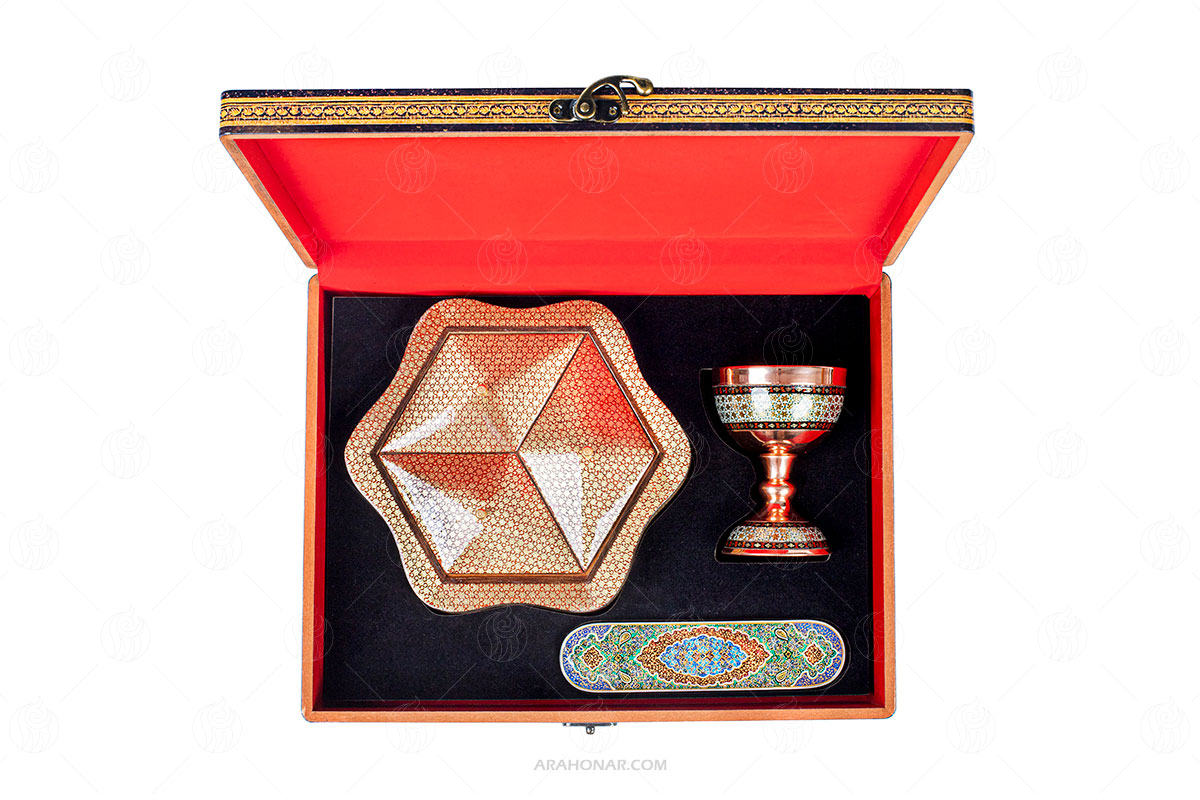
Khatam and Sangab (151) is an exquisite and attractive promotional gift. This collection can be used as management and organizational gifts.
Khatam and Sangab chocolates package (151) shows how much you value your customers. This extremely exquisite package can be an attractive gift for your guests or foreign customers.
The Qoq collection shows off your taste in choosing a gift.
Khatam Kari
Iran's handicrafts are a rainbow of colors, designs, and motifs, and inlaying is a clear example of this artist. Khatam, Khatamsazi or Khatam Kari is an art that is created with small triangles or regular polygons.
These geometric shapes are made of various materials such as bone, wood and metals. from woods such as: ebony (black color), betel nut (black and dark brown), walnut (brown), baqam (red), jujube (light reddish brown), orange (light brown), maple (light brown), kikm Tabrizi (white) and Shamshad (yellow). From bones such as bone and ivory of elephant, camel, cow and horse. From metals, brass, silver and sometimes gold wires.
Historical artifacts of inlaying
* Khatamkari pulpit in the ancient Jame Mosque of Shiraz, which is more than a thousand years old.
* The ceiling of the main porch of the Atiq Jame Mosque in Shiraz, Mariouta, in the 8th century of the Hijri (14th century AD)
*The sealed doors of Timur Gorgani's dream palace named Delgosha in Samarkand and the doors of his tomb in 807 AH (1405 AD)
* Walnut wood doors and bone veneer and other wood made by an artist named Habibullah in 999 Hijri (1591 AD) which is kept in the Berlin Museum.
* Doors decorated with geometric shapes of flowers and plants, from the city of Bukhara, which are available in the Victoria Allerbet Museum
* The wooden pulpit of Lebanon Mosque in Isfahan with geometric shapes and silver components related to the year 1114 AH (1702 AD)
Sangab
One of the traditional handicraft products of Isfahan is Sengab Turquoise Kob. Recently, Kob Turquoise has become popular in Isfahan. And it is performed on all kinds of copper dishes.
Due to the need for high endurance, Firoh Koob products are implemented on copper containers or substructures.
Due to the originality of the artists, the art of turquoise painting has been used on dishes whose shape and foundation are in the history and culture of Iran.
The art of turquoise carving is the arrangement of small pieces of turquoise stone in a bed of copper sea. This art is one of the most beautiful and valuable handicraft arts, which has been developed by Iranian artists among other handicraft arts.
Sengab can be seen in the traditional architecture of Isfahan and the old mosques of this city. Sangab is built in large sizes to hold water at the entrance of mosques and takayas. The role of Sangab was like a small pond.
The turquoises have been worked on these products by hand, the type of turquoise is Neysharbor turquoise and it is also of high quality.
In the old days, it was thought that carrying turquoise would bring victory, and originally the name of this stone was Pirouze, which was later pronounced as Turquoise.
Master Hakimian, known as Ali Reza, was the importer of the art of turquoise painting, and Master Ruben Yerushalami, after training in the presence of Master Eliyahu, and despite enduring poverty and many hardships, was able to revive the art of turquoise painting or turquoise painting, and it is now in Mashhad. The decay was gone, give another boom in Isfahan.
Saler Company Information