
- Seen : 629 View
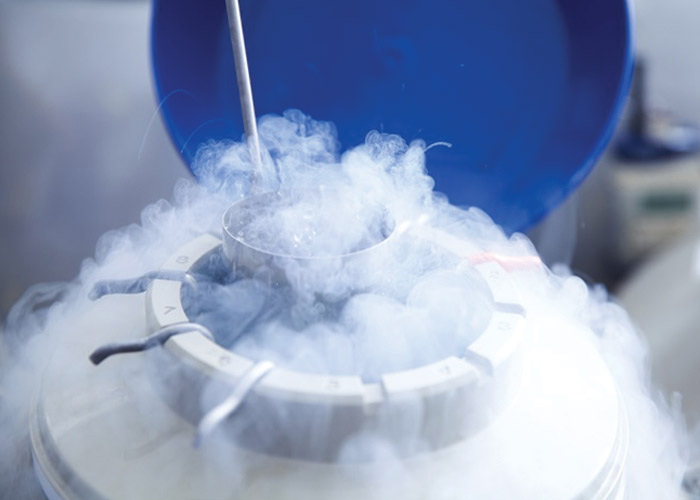
Liquid nitrogen, which is abbreviated as LN2, is the liquid form of pure nitrogen. Liquid nitrogen is extracted from air by distillation and is a colorless, odorless liquid with a density of 807 kg/m (about 20% lighter than water in an equal volume). Liquid nitrogen at a temperature of -196 degrees Celsius, approximately 77 Kelvin on the absolute scale, precisely -195.8 degrees Celsius, turns into steam, which is the same as liquid gas. Liquid nitrogen is shown as LN2-LIN and LN. Due to the very low temperature of liquid nitrogen, its temperature will exceed -196 in the slightest contact with a hotter object, for this reason, for its storage and transportation, any contact with other objects should be prevented. The only solution is to store liquid nitrogen. The use of a liquid nitrogen tank is because it has a vacuum wall and reduces the contact with the surrounding space to almost zero and keeps liquid nitrogen for a long time.
Liquid nitrogen temperature
The temperature of liquid nitrogen is -32 degrees Fahrenheit to -346 degrees Fahrenheit, which freezes and turns into a gas at a temperature less than 63 degrees Kelvin.
The explosive property of nitrogen
Many people avoid gasses due to the fear of exploding, but unlike other gases, nitrogen does not have explosive properties. The expansion coefficient of liquid nitrogen at a normal temperature of 20 degrees Celsius is close to 700, which is one liter of liquid nitrogen. In case of evaporation, it will be equal to 694 liters of nitrogen gas. Therefore, it is recommended not to use liquid nitrogen in closed spaces, the evaporation of even a few liters of liquid nitrogen in a closed space will decrease oxygen and increase nitrogen in the air, which is dangerous. Among other things: it leads to headache, fainting and even death.
Applications of liquid nitrogen
Among the most important uses of liquid nitrogen, the following can be mentioned:
- To freeze and transport food as a cooling liquid in many industries and productions
- Cold therapy to eliminate skin lesions
- Cell storage at low temperature and laboratory work
- Preservation of tissue samples
- Protection of materials against oxygen
- Use in astronomical cameras
- Lowering the temperature of hypermedia and giant systems
Saler Company Information