

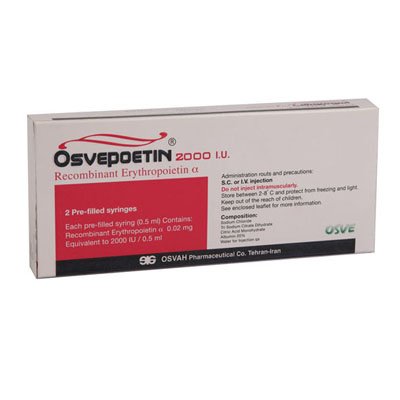
- Seen : 2219 View
Drug Therapy Category:
Blood Factor - Anti-Anemia
Pharmacokinetics:
- Increasing the number of reticulocytes is usually seen within 7 to 10 days, and hemoglobin and hematocrit levels increase within 2 to 6 weeks. The rate and response rate depends on the dose of iron and iron.
- The peak plasma concentration after administration of single dose is 15 minutes and after subcutaneous single dose administration, it is 5 to 24 hours.
- The pharmacokinetics profile of erythropoietin alfa in children similar to adults.
- The half-life of erythropoietin alfa removal after intravenous administration in patients with chronic renal failure is 4 to 13 hours.
The mechanism of the work:
Erythropoietin alfa is a glycoprotein consisting of 165 amino acids produced by recombinant DNA technology. Erythropoietin stimulates the replication and differentiation of erythroid species by interacting with specific receptors of erythropoietin on the surface of the red blood cell precursor cells. It also induces the release of reticulocytes from the bone marrow. Endogenous erythropoietin is produced by the kidneys in response to tissue hypoxia. Anemia due to chronic renal failure is mainly due to insufficient production of this hormone. In patients with renal disease, the level of erythropoietin is usually low. In these patients, the most responding to the administration of erythropoietin exogenous is seen.
Indications:
- Anemia caused by chronic renal failure
- Severe (severe) anemia caused by the administration of zidovudine in HIV patients
Anemia associated with chemotherapy in cancer patients
- Reduced blood transfusion (allogeneic) in patients undergoing surgery.
Amount and method of administration:
- Anemia due to chronic renal failure: Initial dose of 50-50 units / kg is recommended subcutaneously or intravenously, 3 times per week. In patients undergoing hemodialysis, intravenous use is recommended.
- Zidovudine-induced anemia: The recommended starting dose is 4200 mg / week or less of Zidovudine, 100 units / kg subcutaneously or intravenously, 3 times a week for 8 weeks is. If no satisfactory therapeutic response is obtained after 8 weeks, the dosage can be increased to 100-50 units / kg 3 times per week subcutaneously or intravenously, up to 300 units / kg (3 times a week). The treatment response should be reviewed every 4 to 8 weeks.
- Anemia due to chemotherapy in cancer patients: There are two therapeutic regimens in these patients:
1. Use once a week, the initial dose is 40,000 units, subcutaneous.
2. Uses 3 times per week; The initial dosage of 150 units / kg is subcutaneous.
Treatment should not be started in patients with hemoglobin levels of 10 g / dl or more.
- Prevention of blood transfusion (allogeneic) in patients with anemia (hemoglobin level between 10-13 g / dl) undergoing surgery: The recommended dose of erythropoietin in these patients was 300 units / kg / day for 10 days before Surgery is the surgical day and 4 days after it. The substitute dose is 600 units / kg once a week, subcutaneously and on the 21st, 14th and 7th days before surgery and surgery day.
prohibited usage:
- Uncontrolled hypertension
- Sensitivity to human albumin
- Sensitivity to products derived from the mammalian cell system
Precautions:
- In patients with heart disease (such as congestive heart failure, coronary artery disease, thrombosis, etc.)
- Patients with history of hypertension (controlled)
- When there is a possibility of a decrease or delay in response to erythropoietin, administration of the drug is not recommended, such as aluminum poisoning, infection, inflammation, folic acid deficiency and vitamin B12
- Patients with a history of seizure or at risk of seizure
Consumption during pregnancy:
Group C
Consumption during lactation:
The extent of drug secretion in breast milk and its possible side effects for the baby are not well known. It should be noted that in animal studies, administration of 500 kg unit / kg in lactation did not have side effects.
side effects:
Common side effects of the drug include:
- Cardiovascular: hypertension, vascular complications / thrombotic (in coronary artery bypass graft surgery), edema, deep vein thrombosis
Central nervous system: fever, insomnia, headache
- Skin: itching, rash
Gastrointestinal: Nausea, constipation, vomiting, diarrhea, indigestion
- Genitourinary: Infection
- Topical: Injection site reaction
Neurosurculus: Arthralgia, paresthesia
- Respiratory: Cough, congestion, dyspnea, upper respiratory tract infection
Drug Interactions:
No significant drug interactions with erythropoietin are known.
Cyclosporine: Concomitant use of cyclosporine with erythropoietin may exacerbate the effects of hypertension. Cyclosporine and erythropoietin alone can cause elevated blood pressure. In addition, cyclosporine may alter blood levels because cyclosporine binds to red blood cells. (Concomitant use of these two drugs should be considered. The patient's blood pressure should be monitored and cyclosporine should be measured. It may be necessary to adjust the dose of cyclosporine by increasing hematocrit.)
packing:
Injectable syringes of 2000, 4000, 10,000 units in 0.5 ml, 2-digit boxes
How to store:
- Store at 2 to 8 ° C and away from light.
- Keep out of reach of children.
Saler Company Information